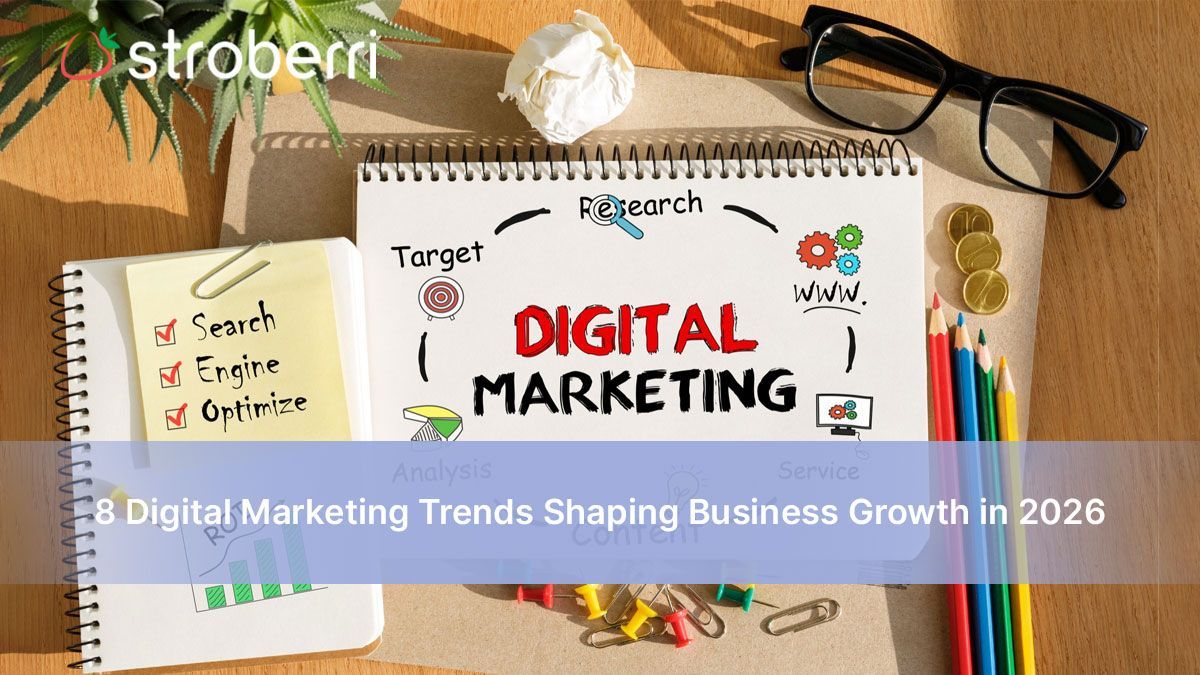
Marketing Trends for 2026: What’s Next for Digital and Offline Promotion
Marketing Trends for 2026: What’s Next for Digital and Offline Promotion
Running a business in 2026 means navigating constant change—new platforms, evolving consumer expectations, and tighter competition across both digital and physical spaces. The brands that win aren’t chasing every trend; they’re choosing the right ones and executing them with intent.
At Stroberri, we work with businesses across Australia to design result-oriented digital marketing, design, and technology solutions. What we’re seeing in 2026 is a clear shift: marketing is becoming more human, more accountable, and more creative—online and offline.
This article breaks down the most important marketing trends for 2026, why they matter, and how businesses can realistically use them to drive growth.
What Are the Top Marketing Trends for 2026?
The defining theme of 2026 marketing is pattern disruption. Audiences are overloaded with ads, automation, and generic content. The brands that stand out are those that feel intentional, authentic, and unexpected—without losing credibility.
Here are the key trends shaping marketing in 2026:
- Mischief Marketing
- Show Your Receipts (Radical Transparency)
- Radical Self-Awareness
- Reactive Absurdism
- Long-Form Influencer Marketing
- Odd Couple Collaborations
- Unexpected but Responsible AI
1. Mischief Marketing: Disrupt to Be Remembered
Mischief Marketing is about playful disruption—small, clever stunts that interrupt routine and spark conversation. These campaigns are designed to be noticed in the real world and amplified online.
What makes this trend powerful in 2026 is its accessibility. You don’t need a massive ad budget—just a strong idea that’s visual, surprising, and shareable.
How businesses can use it:
- Oversized or unexpected product displays
- Interactive shopfronts or pop-ups
- QR-driven experiences with time-limited rewards
- Street-level activations supported by short-form video
The key is simplicity. A well-executed local stunt can outperform a high-spend digital campaign when paired with smart social distribution.
2. Show Your Receipts: Proof Over Promises
Consumers are no longer satisfied with claims—they want evidence. In 2026, transparency is no longer optional; it’s a competitive advantage.
“Show Your Receipts” means backing up what you say with real data, documentation, and openness.
What this looks like in practice:
- Behind-the-scenes content showing how products or services are delivered
- Clear reporting on sustainability, performance, or outcomes
- Openly addressing mistakes and improvements
- Publishing measurable results, not just testimonials
Brands that document their work build trust faster—and trust drives conversion.
3. Radical Self-Awareness: Authenticity That Cuts Through
Radical Self-Awareness is about owning your imperfections and even having fun with them. In a market full of polished messaging, self-aware brands feel honest and confident.
This trend performs especially well on social platforms, where audiences reward brands that sound human—not scripted.
Ways to apply it:
- Address common customer objections openly
- Poke fun at industry clichés
- Share learning moments and behind-the-scenes realities
- Use comments and feedback as content
For businesses, this isn’t about being sloppy—it’s about being real.
4. Reactive Absurdism: Speed Beats Perfection
Reactive Absurdism thrives on speed, timing, and unpredictability. These are campaigns that appear suddenly, feel slightly unhinged (on purpose), and disappear just as fast.
In 2026, attention belongs to brands that can respond to cultural moments in real time.
How to use it safely:
- Create rapid-response content frameworks
- Keep concepts lightweight and reversible
- Test on social before scaling
- Don’t over-explain—let curiosity do the work
This trend rewards agility more than polish.
5. Long-Form Influencer Marketing: Depth Over Reach
Audiences are tired of shallow endorsements. In 2026, long-form influencer content—YouTube, podcasts, newsletters, and in-depth articles—is driving stronger trust and higher conversion.
These formats allow creators to explain why something matters, not just show it.
Smart approaches for businesses:
- Partner with niche creators, not just big names
- Sponsor long-form educational or storytelling content
- Appear as a guest expert rather than a product plug
- Invest in your own long-form channels
Depth builds loyalty, and loyalty compounds.
6. Odd Couple Collaborations: Surprise With Strategy
Unexpected partnerships are one of the strongest attention drivers in 2026. When two brands collaborate across different industries—but shared values—the result feels fresh and highly shareable.
These collaborations don’t have to be physical products. Content, events, and limited experiences work just as well.
Collaboration ideas:
- Cross-industry campaigns
- Local business partnerships
- Co-branded content series
- Limited-time offers or experiences
The best collaborations feel surprising and logical once explained.
7. Unexpected AI: Creative, Transparent, Human
AI is everywhere—but in 2026, the brands winning with AI are those using it creatively and transparently, not as a replacement for people.
Consumers respond best when AI enhances personalisation, creativity, and interaction.
Practical uses of AI:
- Personalised content or design experiences
- Interactive tools or generators
- AI-assisted but human-led campaigns
- Live experiences that involve co-creation
Transparency matters. When AI is part of the process, say so—and keep humans at the centre.
What These Trends Mean for Your Business
The biggest takeaway from 2026 marketing trends is this: standing out requires intention, not excess.
You don’t need to adopt every trend. The most effective strategy is to:
- Choose trends that align with your brand
- Execute them consistently
- Support creativity with strong design, messaging, and technology
Whether it’s a transparent content strategy, a bold collaboration, or a digital-first activation backed by offline presence, the goal is the same—be memorable for the right reasons.
How Stroberri Helps Businesses Grow in 2026
At Stroberri, we help businesses turn trends into measurable growth through:
- Digital marketing strategy
- Branding and creative design
- Web, automation, and technology solutions
- Integrated online and offline campaigns
With teams across Campbelltown (NSW), Rutherford (NSW), and Cranbourne East (VIC), we partner with businesses that want results—not noise.
Call:
02 4032 5661
Email:
solutions@stroberri.com.au